
Key Takeaways
- We recommend anti-ageing treatments based on what is changing in your face, not your age alone. Pigmentation, fine lines, laxity, and volume loss can involve different layers and require different approaches.
- At CLEO Aesthetic, we assess your skin quality, firmness, facial movement, and structural support before deciding what to address.
- Different treatments serve different purposes. Lasers may target pigmentation and texture, energy-based treatments may address laxity, while injectables can support hydration, wrinkles, or facial structure.
- Combining anti-ageing treatments is about addressing different concerns together, not simply doing more treatments.
- Skincare still matters. Consistent sunscreen, suitable active ingredients, and a routine your skin tolerates can help support skin health over time.
- Our Skin Gym approach focuses on gradual, structured care that evolves with your skin, rather than trying to address every sign of ageing at once.
Introduction
Ageing tends to show gradually. Skin may become duller or less smooth, fine lines may become more noticeable, and the cheeks or jawline may start to look less defined.
These changes do not all happen for the same reason. Pigmentation and texture involve the skin itself; reduced firmness can relate to changes in dermal support; expression lines are influenced by muscle movement; and flattening or hollowing can involve deeper changes in facial volume and structure.
This is why our approach to anti-ageing treatments starts with a simple question: what is changing, and at which layer? Below, we discuss what may be worth treating now, what can be supported gradually, and what may not need treatment at all.
How Does Our Skin Change As We Age?
Ageing affects the skin in several ways, and these changes do not all happen at the same pace. Some affect the surface, while others gradually change how firm, hydrated, or even the skin looks.
1. Skin Cell Turnover Slows
Our skin continually sheds older cells and replaces them with newer ones. As we age, this natural renewal process slows, so dead skin cells can stay on the surface longer. This can make the skin feel rougher and look duller or less even. It may also take longer for the skin to recover from irritation or environmental stress than it did when you were younger.
2. Collagen and Elastin Support Declines
Collagen gives the skin strength and structure, while elastin lets it stretch and return to shape. Over time, we produce less collagen, and the collagen and elastin already present in the skin gradually become less organised and effective. As this support weakens, the skin can become thinner and less firm. Fine lines may become more noticeable, while areas such as the cheeks, jawline, and neck can gradually start to look less taut.
3. The Skin Becomes Drier
As we age, the skin also becomes less able to retain moisture. Natural hyaluronic acid levels decline, while changes in the skin barrier can make it easier for moisture to escape. As a result, the skin may feel drier, less supple, or less “bouncy”. Dehydration can also make existing fine lines stand out more, even before significant laxity or volume loss.
4. Pigmentation Becomes More Uneven
Years of sun exposure gradually affect how the skin produces and distributes pigment. Over time, this can become visible as freckles, sun spots, or patches of uneven tone. UV exposure also contributes to collagen breakdown, so repeated sun exposure can make changes in texture, fine lines, and firmness more noticeable.
CLEO Aesthetic: Our Approach to Anti-Ageing Treatments and Skin Rejuvenation
When someone comes to us concerned about facial ageing, we do not start with a predetermined set of procedures. Instead, we assess where the most relevant changes occur before determining an appropriate anti-ageing treatment plan.
Broadly, we consider four key areas: the quality of the skin itself, firmness and laxity, expression-related wrinkles, and deeper changes in facial structure.
1. Reduced Skin Quality: Tone, Texture, Hydration, and Fine Lines
We generally start by looking at the skin itself. Facial contours may still be well supported, but the skin can begin to look duller, feel rougher or drier, and show early changes in pigmentation, pores, and fine lines.
Signs we may look for include:
- Uneven pigmentation, including freckles, sun spots, or patchy tone
- Dullness or reduced brightness
- Rough or uneven texture
- More visible pores
- Fine lines, particularly when the skin is dehydrated
- Dryness or reduced suppleness
Rather than treating all these changes as one general “anti-ageing” concern, we consider which aspect of skin quality contributes most.
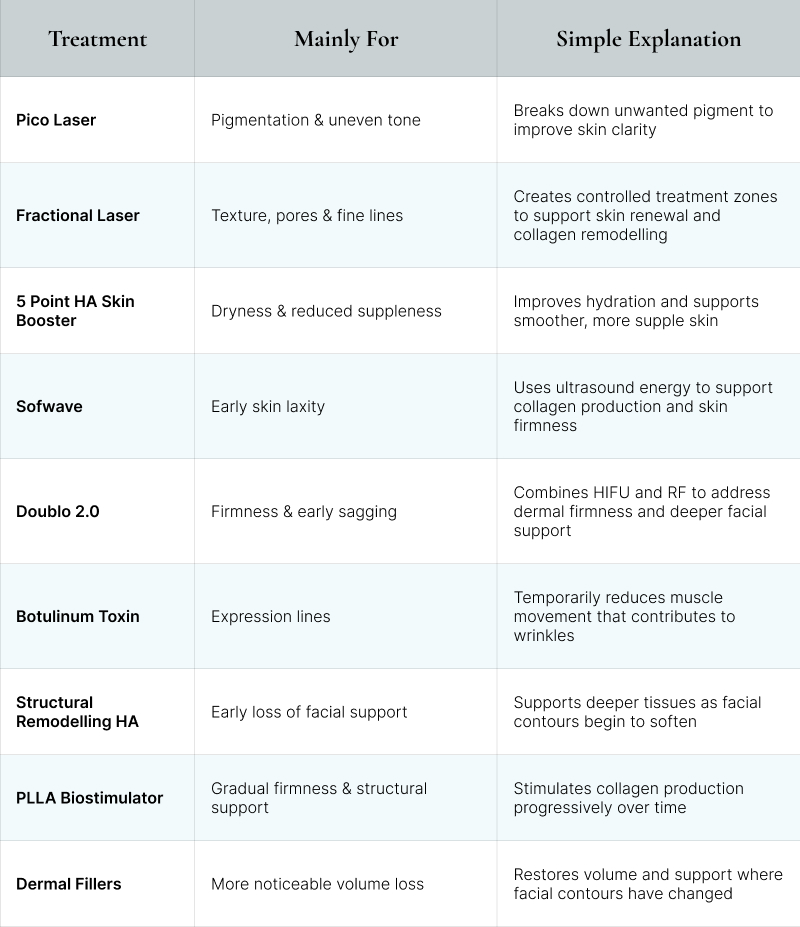
Pico Laser
We may consider Pico laser treatments for anti-ageing when freckles, sun spots, or uneven pigmentation are the main concern. The laser delivers ultra-short pulses that create a photoacoustic effect, breaking pigment into smaller fragments without relying primarily on heat. The body then gradually clears these fragments through its natural processes.
Fractional Laser
When rough texture, enlarged pores, or fine lines are more noticeable, fractional laser treatment may be more relevant. It creates microscopic treatment zones within the skin, triggering a controlled repair response and supporting collagen remodelling while leaving surrounding tissue intact.
We can also adjust the type of fractional laser used based on your concern and expected recovery. Fractional picosecond lasers create microscopic changes beneath the skin to support collagen production and texture refinement, generally with more limited downtime. By contrast, fractional CO₂ laser is ablative and resurfaces small columns of skin while providing deeper collagen stimulation and remodelling, making it suitable for more significant resurfacing needs but with a longer recovery period.
5 Point Hyaluronic Acid (HA) Skin Booster
If the skin feels drier, less smooth, or less supple, we may consider a 5 Point HA skin booster. Hyaluronic acid attracts and retains water within the skin, helping to improve hydration and overall skin quality. Unlike a dermal filler, this anti-ageing treatment aims to improve skin condition rather than add volume or reshape facial contours.
2. Loss of Firmness and Early Laxity
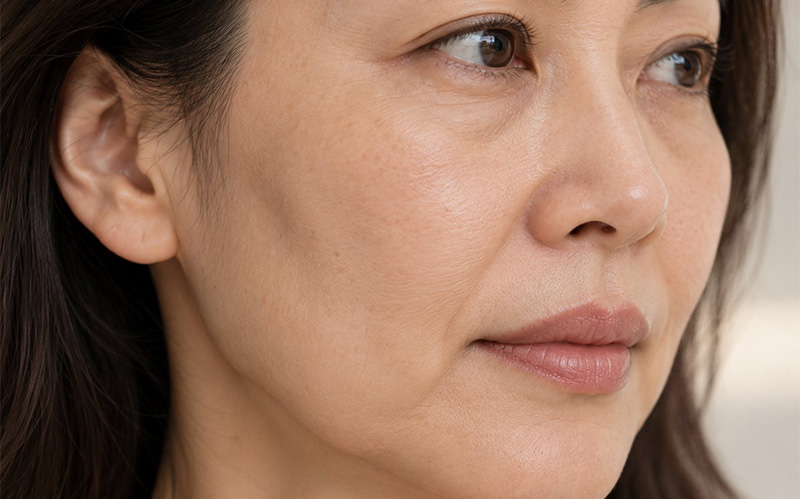
When the skin starts to feel less firm, we look beyond surface concerns such as pigmentation and texture. At this stage, changes in collagen and deeper facial support can make the skin sit differently over the face.
Signs we may look for include:
- A softer or less defined jawline
- Early sagging through the cheeks or lower face
- Mild laxity around the brow
- Looser skin around the neck
For these concerns, treatment depth matters. Different non-invasive skin tightening treatments deliver energy to different tissue layers, so we consider where the laxity is occurring before deciding which anti-ageing treatment approach may be suitable.
Synchronous Ultrasound Parallel Beam (SUPERB™) Technology
A treatment like Sofwave uses Synchronous Ultrasound Parallel Beam (SUPERB™) technology to deliver controlled ultrasound energy into the mid-dermis, where collagen is found. The resulting heat stimulates processes involved in new collagen production and remodelling.
Since this treatment works within the dermis rather than targeting the underlying fat layer, we may consider it when the main concern is reduced skin firmness or early laxity around areas such as the cheeks, jawline, neck, or brows. Results develop gradually as the skin responds and produces new collagen.
Doublo 2.0
When laxity involves both the dermis and deeper supporting tissues, we may consider CLEO Doublo 2.0, which combines High-Intensity Focused Ultrasound (HIFU) with radiofrequency (RF) skin tightening.
HIFU penetrates deeper into the skin layers, reaching down to 4.5mm to target the Superficial Musculoaponeurotic System (SMAS) layer. It concentrates ultrasound energy at specific points beneath the skin, creating controlled thermal zones within deeper tissues involved in facial support. This can trigger tissue contraction and collagen remodelling over time, helping to address early sagging or reduced definition in areas like the lower face and jawline.
Rather than concentrating energy at individual points, RF skin tightening treatments generate controlled heat within collagen-rich dermal tissue. This heating stimulates processes involved in collagen production and remodelling, helping to address reduced firmness and elasticity closer to the skin surface.
3. Expression-Related Wrinkles
Some wrinkles are caused primarily by movement rather than declining skin quality. Each time you raise your eyebrows, frown, or smile, facial muscles contract and crease the overlying skin. These lines usually appear only during expression at first, but repeated movement can make them increasingly visible at rest over time.
Common examples include:
- Forehead lines when raising the brows
- Frown lines between the eyebrows
- Crow’s feet around the eyes
Botulinum toxin
When muscle movement is the main contributor, our doctors may consider botulinum toxin treatment. Small amounts are injected into selected muscles to temporarily reduce their contraction, which can soften dynamic wrinkles and reduce the repeated folding that may make these lines more deeply etched over time.
Botulinum toxin does not directly remove static wrinkles that are already present at rest. If these lines also involve changes in skin quality or dermal support, we may consider other anti-ageing treatments separately.
4. Structural Changes in Volume and Facial Support
As facial ageing progresses, some changes occur deeper than the skin. Facial volume and structural support can gradually shift, changing how light and shadow fall across the face and making certain areas appear flatter, hollower, or less defined.
Signs we may look for include:
- Flattening through the cheeks or midface
- Hollowing around the temples or cheeks
- Reduced cheek definition
- More noticeable folds and shadows
- Reduced jawline definition
Structural Remodelling HA
Our doctors may recommend structural remodelling HA skin boosters when your midface starts to look flatter or facial contours are becoming softer, but significant volume loss has not yet occurred.
The HA is placed within deeper structural tissues to provide support as early changes in facial shape begin to appear. The aim is to gradually reinforce areas such as the cheeks and midface, helping maintain facial contours and structural balance as these tissues change over time.
Poly-L-lactic acid (PLLA) Biostimulators
When reduced firmness and early volume changes are developing more gradually, we may consider PLLA biostimulators. After injection, microscopic PLLA particles stimulate the body’s collagen-building processes, helping to strengthen the skin’s underlying support over time.
This process takes place progressively over several weeks to months as new collagen develops. PLLA may therefore be considered when the treatment goal is gradual improvement in firmness, tissue support, and early volume changes rather than an immediate change in facial contours.
Dermal Fillers
When volume loss is more established, dermal fillers may be considered to restore support in areas that have become flatter or more hollow. Depending on the pattern of change, this may include areas such as the cheeks, temples, or other parts of the face where reduced volume is affecting overall proportions.
Our doctors will assess facial proportions, bone structure, and how volume has shifted rather than treating each visible fold or hollow in isolation. This helps determine where additional support may be appropriate and how much is needed.
How We Combine Anti-Ageing Treatments
Age-related changes often overlap. You might have pigmentation alongside early laxity, or enlarged pores and fine lines without much change in facial structure.
When more than one concern is present, we may combine anti-ageing treatments that work at different depths or serve different purposes. The aim is not to add more procedures, but to make sure each treatment has a clear role.
| What We See | Treatments We May Consider |
|---|---|
| Uneven tone + rough texture + early changes in skin quality | Pico laser + bio-remodelling hyaluronic acid |
| Texture + enlarged pores + fine lines + reduced dermal support | Fractional laser + Type I collagen skin booster |
| Reduced firmness + early sagging | Sofwave or Doublo 2.0 |
| Laxity + flatter facial contours | Sofwave or Doublo 2.0 + structural remodelling HA, PLLA biostimulator, or dermal filler |
| Expression lines + declining skin quality | Botulinum toxin + bio-remodelling HA or fractional laser |
| Pigmentation + texture + reduced dermal quality | CLEO Skin Renewal |
When deciding whether a combination is appropriate, our doctors consider three things:
- What needs to be addressed first? Not every visible change needs treatment at the same time. We prioritise the concerns that are most relevant to your skin and facial structure.
- Where is the change occurring? An anti-ageing treatment for surface pigmentation requires a different approach than reduced dermal firmness or deeper loss of facial support.
- Does each treatment add something useful? Combining treatments makes sense when they address different parts of the ageing process, rather than duplicating the same function.
This also means a combination anti-ageing treatment plan does not necessarily involve doing everything at once. Treatments can be introduced progressively and adjusted according to how your skin responds, which is consistent with our Skin Gym approach to structured, ongoing care.
How Skincare Fits Into an Anti-Ageing Plan
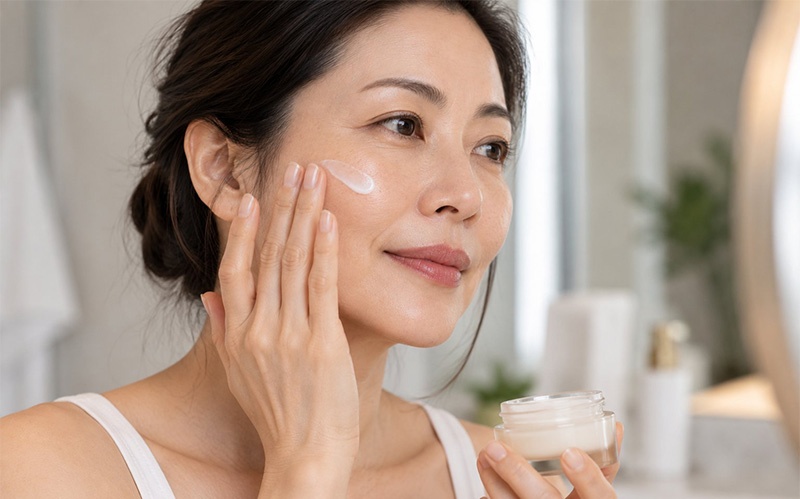
In-clinic anti-ageing treatments are only part of the plan. What you do consistently at home can also help maintain skin quality and support your skin between treatments.
- Use sunscreen daily. Broad-spectrum sunscreen helps reduce ongoing UV exposure, which contributes to pigmentation, collagen breakdown, and other signs of photoageing.
- Choose actives based on your concerns. Retinoids may help with fine lines and texture, while ingredients such as vitamin C or niacinamide may help with uneven tone. What is suitable depends on your skin and its tolerance.
- Introduce products gradually. Adding several strong actives at once can increase irritation and make it difficult to identify what is actually helping.
- Adjust your routine around treatments. After certain laser, injectable, or energy-based procedures, you may need to temporarily simplify your routine and prioritise gentle cleansing, moisturising, and sun protection according to your doctor’s advice.
- Review your routine as your skin changes. What your skin needs can shift with age, lifestyle, hormonal changes, treatment history, and sensitivity.
For younger patients, an anti-ageing treatment plan does not necessarily mean starting multiple procedures early. Consistent sun protection, appropriate skincare, and reviewing changes as they develop may be enough until there is a specific concern worth addressing.
Conclusion
Ageing does not happen in one layer of the skin, so there is rarely one anti-ageing treatment that fits every concern. Pigmentation, texture, fine lines, laxity, facial movement, and volume changes can each have different underlying causes. A more useful approach is to understand what has changed, where it’s occurring, and what is worth addressing now. Some concerns may benefit from a combinationanti-ageing treatment plan, while others may simply need consistent skincare and monitoring over time.
At CLEO Aesthetic, we call this our Skin Gym philosophy. Much like physical fitness, maintaining your skin is an ongoing process rather than something achieved through one intensive session. We assess where your skin is now, identify the areas that need attention, and build a plan that can progress as your skin changes.
Start by understanding what your skin actually needs. Book a consultation at CLEO Aesthetic for a doctor-led assessment of your skin today.
Frequently Asked Questions
1. Can anti-ageing treatments be used on the neck and hands?
Yes. Age-related changes can also affect the neck and hands, including pigmentation, dryness, fine lines, and reduced firmness. The right treatment depends on your concerns, skin condition, and the area being treated.
2. What should I tell my doctor before starting anti-ageing treatments?
Let your doctor know about your current skincare products, medications, allergies, previous aesthetic procedures, and any history of skin sensitivity or post-treatment pigmentation. This helps them assess which treatments may be suitable for you.
3. Can skin ageing actually be reversed?
The ageing process itself cannot be reversed, but some of its visible effects can be managed. Depending on the underlying cause, anti-ageing treatments and skincare may help improve concerns such as pigmentation, fine lines, uneven texture, and reduced firmness over time.
 CLEO Aesthetics